GUPPI
Ask your rig a question and get an answer from its live state: “How’s guiding?” — and the answer comes from the guider’s actual RMS right now, not from a canned response or a cloud service. GUPPI — Ground Unit Primary Peripheral Interface — is the rig’s onboard intelligence. It is one product with two power levels: a built-in brain that runs on the rig itself, and a socket for plugging in an agent you already use. One safety model governs both.
Open it from the telescope glyph in the app header. On desktop it is a side panel; on a phone it is a bottom sheet — always titled with the rig’s name, because every conversation is grounded in one rig’s live state.
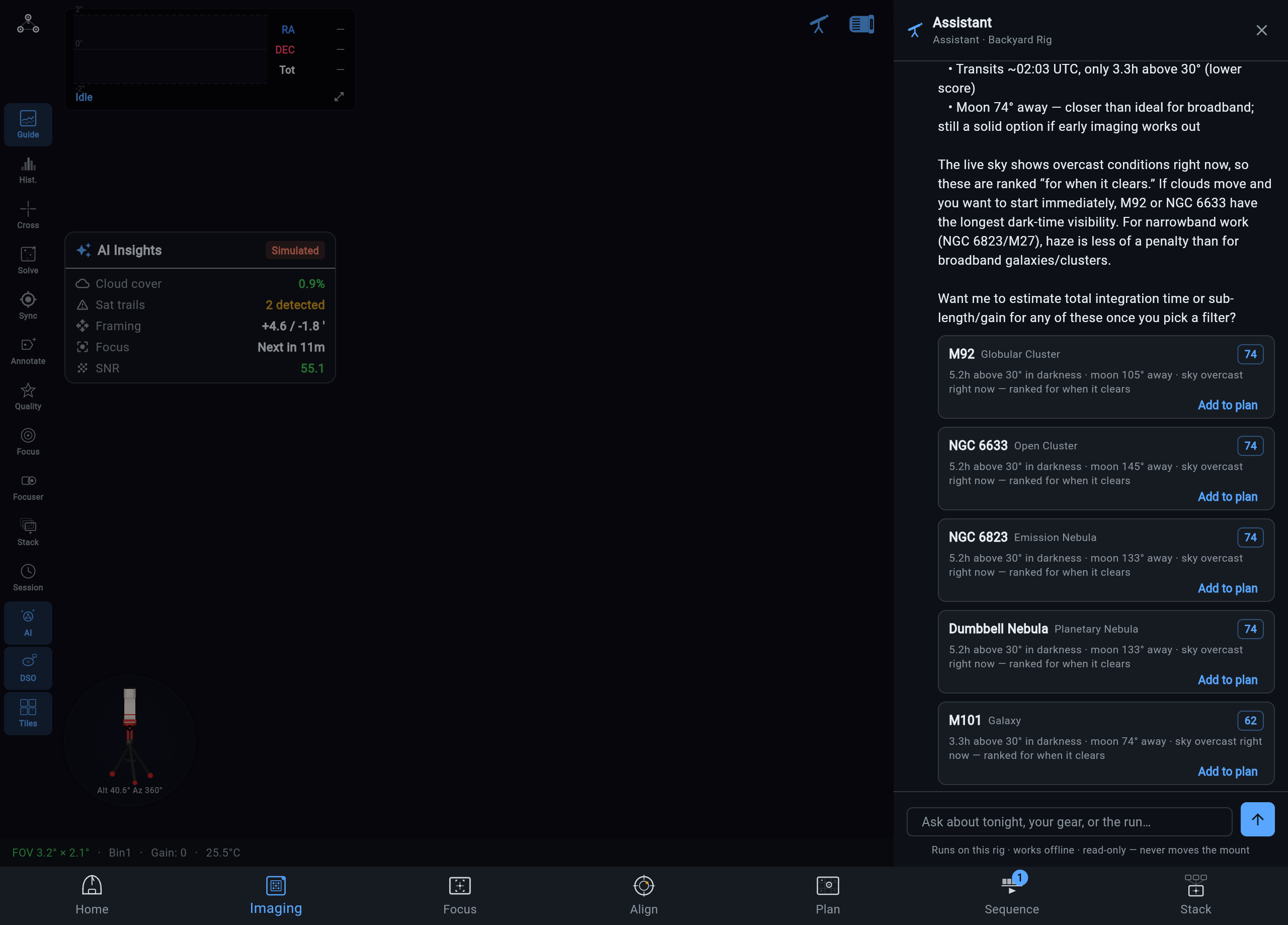
GUPPI, out of the box
Section titled “GUPPI, out of the box”The built-in brain runs entirely on the rig. GPU-accelerated rig computers have the headroom to run the full local model alongside capture; a bare Raspberry Pi answers the same core questions deterministically — no model on board, so answers are instant and every number still comes straight from the rig’s own tools. Either way it is private by design — your questions and images never leave home — and it works with zero internet.
What you can ask
Section titled “What you can ask”The built-in brain reads live telemetry through a fixed set of rig tools:
- Guiding — current RMS, guide star health, and whether that wobble is seeing or something worth fixing.
- Sequence progress — what is running, frames completed, and the ETA.
- Conditions — tonight’s forecast and the golden windows worth imaging (see Weather Intelligence).
- Sky state — what the all-sky camera reads right now, if you have one set up (see SkyNode).
- Last night — “What happened last night?” reads the Guardian night journal and gives you the postmortem: what completed, what held, what recovered on its own.
- Targets — “What should I shoot tonight?” returns recommendations scored for your camera, optics, and site — not a generic top-ten list. Each suggestion carries a one-tap Add to Plan that drops the target straight into a Plan draft for review.
Answers show their work. The panel displays which rig tools were consulted for each reply, and when GUPPI explains a concept — what a good RMS looks like, why stars bloat in poor seeing — it cites a curated astrophotography knowledge base rather than improvising.
When it doesn’t have data, it says so. A rig with no forecast source gets an honest “I can’t see a forecast,” not an invented one. And the built-in brain only talks astronomy — off-topic questions are declined before they ever reach the model.
Private by design
Section titled “Private by design”- The brain runs on your rig computer. Your questions, the answers, and every piece of telemetry they touch stay on your network. Nothing is sent to a cloud service, and nothing is used for training.
- It works offline. At a dark site with zero internet, everything grounded in rig state still answers — guiding, sequence, journal, targets. Only internet-backed data such as the weather forecast degrades, and GUPPI tells you when that happens.
- It never touches your images. The built-in brain reads telemetry and status, not your data files.
GUPPI + your own agent
Section titled “GUPPI + your own agent”The built-in brain is the out-of-the-box power level, not the ceiling. Every ARIS rig exposes GUPPI over MCP (Model Context Protocol), the open standard AI agents use to reach tools — so an agent you already run can plug into the rig: Claude, ChatGPT, or anything else that speaks MCP, down to a local model on your own machine.
A connected agent sees the same live rig the built-in brain does — guiding, sequence, conditions, journal — and it can act: start and manage sequences, run autofocus, change filters. How far it may go is set by its trust dial, below.
One honest note: the privacy guarantees above describe the built-in brain. Plug in a cloud agent and what it reads travels to that agent’s service, on that service’s terms — a trade you make per agent, never by default.
One trust dial for every brain
Section titled “One trust dial for every brain”Every brain connected to a rig — the built-in one included — has its own trust dial, and the dial decides what it may do:
- Watch-only — read telemetry and answer questions. No control, full stop.
- Ask before motion — the agent can act, but anything that moves hardware waits for your confirmation.
- Full autopilot — the agent acts on its own, and every action lands in the night journal.
The built-in brain ships in watch-only. And wherever a dial sits, Guardian’s hard limits stay on: every action any agent takes goes through the same interlocked, safety-checked rig operations you would trigger yourself. An agent chooses actions by name and explains why — it never composes device commands.
For overnight recovery specifically, Guardian playbooks define the named actions the built-in brain can queue — restart the guiding software, re-run autofocus, safe-park the mount — each a deterministic backend command with its own interlocks, off by default, with a per-playbook autonomy tier you control.
Availability
Section titled “Availability”GUPPI is included with paid ARIS plans, Hobbyist and up.
It is in early access. Expect it to keep getting smarter — and occasionally to be wrong. The grounding in live telemetry and visible tool calls exists exactly so you can check its work.